What Are Macros and Why Do They Matter More Than Calories?
You’ve been counting calories for months, but your body composition isn’t changing the way you hoped. You’re hitting your calorie target, but you still feel hungry, tired, or stuck at the same weight. The problem isn’t your effort. It’s that calories only tell half the story.
Macros (macronutrients) are the three nutrients your body needs in large amounts: protein, carbohydrates, and fats. Each plays a distinct role in energy, muscle building, and hormone production. Tracking macros instead of just calories helps you eat the right balance for fat loss, muscle gain, and sustained energy, giving you control over your body composition, not just your weight.
Understanding macronutrients and their roles
Macros is short for macronutrients, the three types of nutrients that make up nearly everything you eat.
They are protein, carbohydrates, and fats.
Each macro has a specific job in your body, and each provides a different amount of energy per gram:
- Protein: 4 calories per gram
- Carbohydrates: 4 calories per gram
- Fats: 9 calories per gram
Your body can’t function without all three. Protein builds and repairs muscle tissue. Carbs provide immediate energy for workouts and brain function. Fats support hormone production, vitamin absorption, and long-term energy storage.
Two meals can have the exact same calorie count but wildly different macro breakdowns. A 400-calorie breakfast of eggs, avocado, and whole-grain toast will fuel your body very differently than a 400-calorie muffin.
The first meal gives you protein for muscle repair, healthy fats for satiety, and complex carbs for steady energy. The second spikes your blood sugar, leaves you hungry an hour later, and offers little nutritional value.
That’s why macros matter more than calories alone.
Why tracking macros beats counting calories
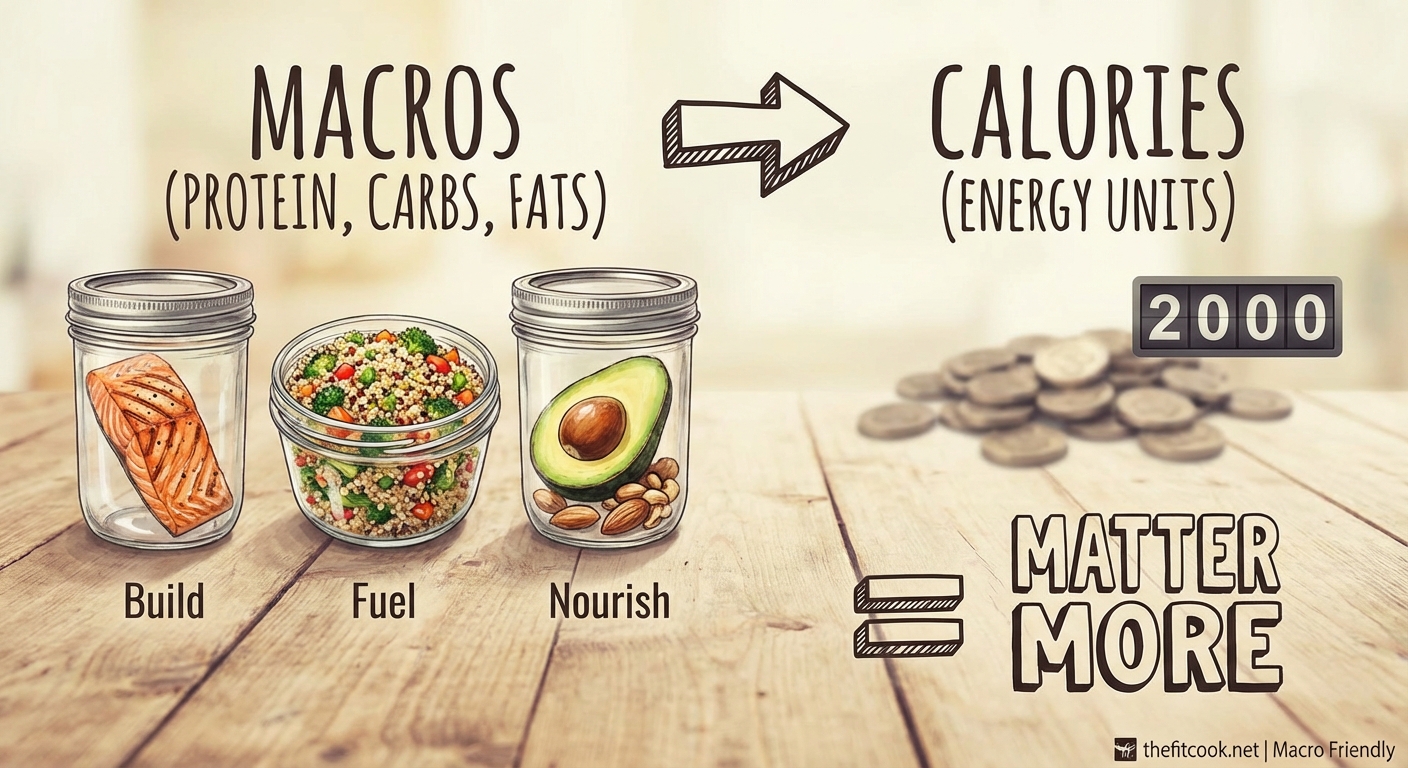
Calorie counting assumes all energy is equal. But your body doesn’t work that way.
Eating 2,000 calories of protein, vegetables, and whole grains will produce completely different results than 2,000 calories of processed snacks and sugary drinks.
Here’s what happens when you focus only on calories:
- You might lose weight, but you’ll also lose muscle.
- You’ll feel hungry more often because you’re not eating enough protein or fat.
- Your energy will crash between meals.
- Your workouts will suffer because you’re not fueling properly.
When you track macros, you control what your body does with the food you eat.
Want to build muscle? You need enough protein to repair tissue after training. Want to lose fat without feeling miserable? You need enough fat to stay satisfied and enough carbs to fuel your workouts.
Macro tracking gives you precision. It turns your diet into a tool you can adjust based on your goals, not just a number you try to stay under.
“Calories determine whether you gain or lose weight. Macros determine whether that weight is muscle or fat.”
Breaking down the three macronutrients
Let’s look at what each macro actually does and why you need all three.
Protein builds and repairs your body
Protein is made of amino acids, the building blocks your body uses to repair muscle, skin, hair, and organs.
When you lift weights or do any kind of resistance training, you create tiny tears in your muscle fibers. Protein repairs those tears, making your muscles stronger and bigger over time.
Protein also keeps you full longer than carbs or fats. It has the highest thermic effect, meaning your body burns more calories digesting it.
Good sources of protein include:
- Chicken breast
- Lean beef
- Fish and seafood
- Eggs
- Greek yogurt
- Cottage cheese
- Tofu and tempeh
- Protein powder
If you’re trying to lose fat or build muscle, protein should be your priority. Most people need between 0.7 and 1 gram of protein per pound of body weight, depending on their activity level and goals.
If you’re prepping meals in advance, learning how to meal prep 150g protein daily without getting bored can make hitting your target much easier.
Carbohydrates fuel your workouts and brain
Carbs are your body’s preferred source of immediate energy. They break down into glucose, which your muscles and brain use for fuel.
When you eat carbs, your body stores some as glycogen in your muscles and liver. During intense exercise, your body taps into those glycogen stores to keep you going.
Carbs also support recovery. After a hard workout, eating carbs helps replenish glycogen and kickstart the muscle repair process.
Not all carbs are created equal. Complex carbs like oats, sweet potatoes, and brown rice digest slowly and provide steady energy. Simple carbs like candy and white bread spike your blood sugar and leave you crashing later.
Good sources of complex carbs include:
- Oats
- Sweet potatoes
- Brown rice
- Quinoa
- Whole-grain bread
- Fruits
- Vegetables
If you’re cutting carbs to lose fat, you might feel tired, irritable, or weak in the gym. That’s because your body doesn’t have enough fuel for high-intensity work. Carbs aren’t the enemy. Eating the wrong types or too many for your activity level is the problem.
For ideas on balancing carbs with other macros, check out how to build the perfect low carb plate for fat loss and muscle retention.
Fats support hormones and long-term energy
Fat gets a bad reputation, but it’s essential for health. Your body needs fat to produce hormones like testosterone and estrogen, absorb vitamins A, D, E, and K, and protect your organs.
Fat also keeps you satisfied. It digests slowly, so it helps you feel full between meals. If you’re constantly hungry on a low-fat diet, that’s why.
There are different types of fats:
- Saturated fats: Found in meat, butter, and coconut oil. Fine in moderation.
- Unsaturated fats: Found in olive oil, avocados, nuts, and fish. These are anti-inflammatory and heart-healthy.
- Trans fats: Found in processed foods. Avoid these completely.
Good sources of healthy fats include:
- Avocados
- Nuts and nut butters
- Seeds
- Olive oil
- Fatty fish like salmon
- Eggs
- Dark chocolate
Most people need between 20% and 35% of their total calories from fat. Going too low can mess with your hormones, energy, and mood.
How to calculate your macro needs
Figuring out your macros takes a few steps, but it’s not complicated.
Here’s the process:
- Calculate your total daily energy expenditure (TDEE). This is how many calories you burn in a day based on your age, weight, activity level, and goals. You can use an online TDEE calculator or work with a coach.
- Set your protein target. Start with 0.7 to 1 gram per pound of body weight. If you weigh 150 pounds, aim for 105 to 150 grams of protein per day.
- Set your fat target. Aim for 20% to 30% of your total calories. If you eat 2,000 calories per day, that’s 400 to 600 calories from fat, or about 44 to 67 grams.
- Fill the rest with carbs. Whatever calories are left after protein and fat go to carbs. Using the example above, if you’ve allocated 600 calories to protein (150g x 4) and 500 calories to fat (55g x 9), you have 900 calories left for carbs, which is 225 grams.
Your macro needs will change based on your goals. If you want to lose fat, you’ll eat fewer total calories but keep protein high. If you want to build muscle, you’ll eat more calories overall and increase carbs to fuel training.
For a detailed breakdown, read how to calculate your macros for fat loss and muscle gain.
Common mistakes people make with macros
Even when you understand macros, it’s easy to mess up the execution.
Here are the most common mistakes and how to avoid them:
| Mistake | Why it hurts you | How to fix it |
|---|---|---|
| Not eating enough protein | You lose muscle when cutting, don’t recover from workouts, and stay hungry | Prioritize protein at every meal and track your intake |
| Cutting carbs too low | You feel tired, workouts suffer, and your metabolism slows down | Keep carbs high enough to fuel your activity level |
| Avoiding fats completely | Hormones tank, you feel hungry all the time, and energy crashes | Include healthy fats at most meals |
| Not tracking consistently | You think you’re hitting your macros but you’re way off | Weigh and log your food for at least a few weeks to learn portion sizes |
| Obsessing over perfection | You stress about hitting exact numbers and lose the bigger picture | Aim for 90% consistency and adjust as you go |
Tracking macros is a skill. It takes practice. You won’t nail it perfectly on day one, and that’s fine.
Putting macros into practice with real meals
Understanding macros is one thing. Building meals around them is another.
Let’s look at a few examples of balanced meals that hit all three macros:
Breakfast: Scrambled eggs with avocado and oats
– 3 whole eggs (18g protein, 15g fat)
– 1/2 avocado (2g protein, 12g fat, 9g carbs)
– 1/2 cup cooked oats (5g protein, 3g fat, 27g carbs)
Total: 25g protein, 30g fat, 36g carbs
Lunch: Grilled chicken with sweet potato and broccoli
– 6 oz chicken breast (52g protein, 3g fat)
– 1 medium sweet potato (2g protein, 0g fat, 27g carbs)
– 1 cup steamed broccoli (3g protein, 0g fat, 6g carbs)
– 1 tbsp olive oil (0g protein, 14g fat, 0g carbs)
Total: 57g protein, 17g fat, 33g carbs
Dinner: Salmon with quinoa and roasted vegetables
– 5 oz salmon (35g protein, 12g fat)
– 1 cup cooked quinoa (8g protein, 4g fat, 39g carbs)
– 1 cup roasted vegetables (2g protein, 0g fat, 10g carbs)
Total: 45g protein, 16g fat, 49g carbs
Notice how each meal includes all three macros. You’re getting protein for muscle repair, carbs for energy, and fats for satiety and hormone support.
If you’re short on time, try 15-minute high-protein dinners that actually keep you full to stay on track without spending hours in the kitchen.
Adjusting macros based on your goals
Your macro split isn’t set in stone. It should change based on what you’re trying to achieve.
Here’s how to adjust:
For fat loss:
– Keep protein high (1g per pound of body weight)
– Moderate carbs (focus on training days)
– Moderate fats (20% to 25% of total calories)
– Create a calorie deficit of 300 to 500 calories below maintenance
For muscle gain:
– Keep protein high (0.8 to 1g per pound)
– Increase carbs significantly to fuel workouts and recovery
– Moderate fats (20% to 30% of total calories)
– Eat in a calorie surplus of 200 to 300 calories above maintenance
For maintenance:
– Moderate protein (0.7 to 0.8g per pound)
– Balanced carbs and fats based on preference
– Eat at your TDEE
Your activity level also matters. If you’re training hard five days a week, you need more carbs than someone who walks for 30 minutes a day.
Pay attention to how you feel. If you’re dragging through workouts, add carbs. If you’re always hungry, add protein or fat. If you’re not recovering well, check your overall calorie intake.
Tools and apps to track your macros
You don’t need fancy equipment to track macros, but a few tools make it easier.
Food scale:
This is the most important tool. Eyeballing portions is notoriously inaccurate. A digital food scale costs less than $15 and gives you exact measurements.
Tracking apps:
Apps like MyFitnessPal, Cronometer, or MacroFactor let you log meals and see your macro breakdown in real time. Most have barcode scanners and large food databases.
Meal prep containers:
Prepping meals in advance takes the guesswork out of hitting your macros. Use containers with dividers to portion protein, carbs, and veggies.
If you’re new to meal prep, start with the ultimate macro-friendly freezer meal prep guide for beginners to build meals you can store and reheat all week.
Why macros work better than restrictive diets
Most diets fail because they’re built on restriction. You cut out entire food groups, follow rigid rules, and feel miserable until you eventually give up.
Macro tracking is different. It’s flexible.
You can eat the foods you enjoy as long as they fit your macro targets. Want a slice of pizza? Fine. Just make sure the rest of your day balances it out with enough protein and vegetables.
This approach is called flexible dieting or “If It Fits Your Macros” (IIFYM). It’s sustainable because it doesn’t require perfection or deprivation.
You’re not cutting carbs forever. You’re not avoiding fat. You’re eating a balanced diet that supports your goals and your lifestyle.
That’s why people stick with it. It works with your life instead of against it.
For more on this approach, read the ultimate guide to flexible dieting with macro-counted recipes.
Making macros work in the real world
Tracking macros doesn’t mean you can never eat out or enjoy a meal with friends. It just means you plan ahead.
Here’s how to stay on track:
- Check restaurant menus online before you go and choose a meal that fits your macros.
- Order grilled protein, ask for sauces on the side, and swap fries for vegetables.
- If you know you’re having a big dinner, eat lighter earlier in the day to save room.
- Don’t stress if one meal puts you over. Get back on track the next day.
Life happens. You’ll have days where you don’t hit your targets perfectly. That’s normal. Consistency over weeks and months matters more than one meal or one day.
Fueling your body with purpose
Macros aren’t just numbers on a nutrition label. They’re the building blocks your body uses to perform, recover, and change.
When you understand what macros are and how to balance them, you stop guessing. You stop spinning your wheels on diets that don’t work. You start eating with intention, and your body responds.
You’ll have more energy in the gym. You’ll recover faster. You’ll see your body composition improve, not just your weight on the scale.
Start simple. Track your food for a week to see where you’re at now. Then adjust one macro at a time. Add more protein if you’re falling short. Increase carbs if your workouts feel flat. Add healthy fats if you’re always hungry.
Your macros are your roadmap. Follow them, and you’ll get where you want to go.